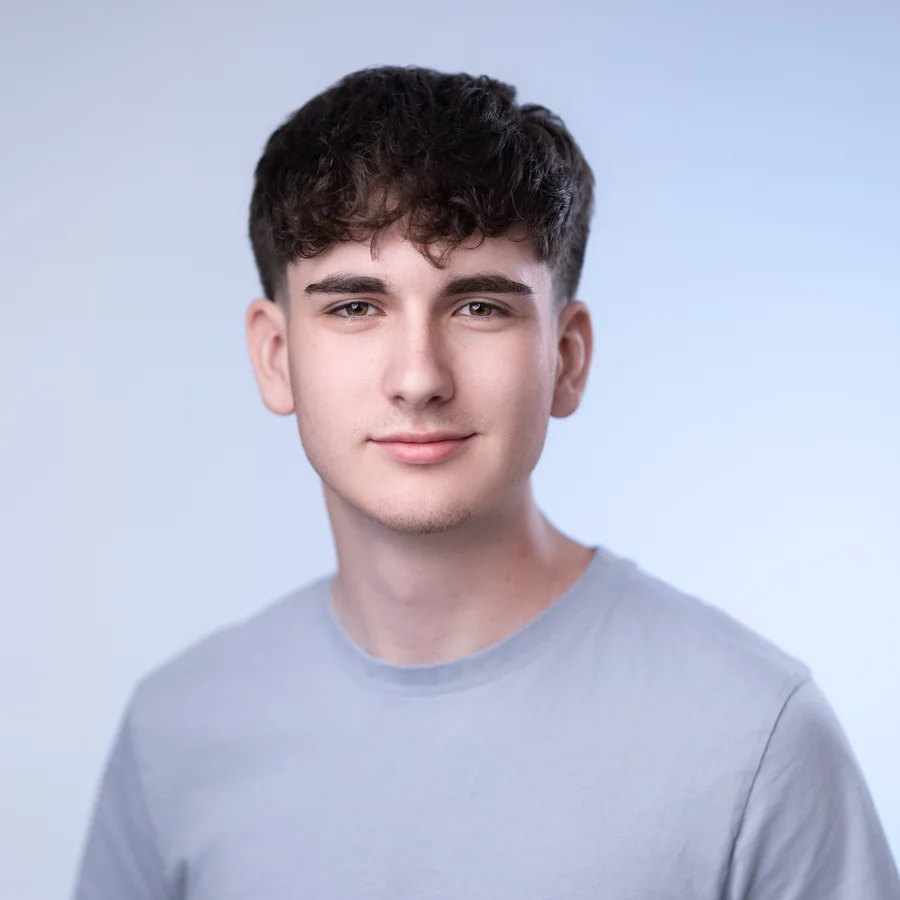
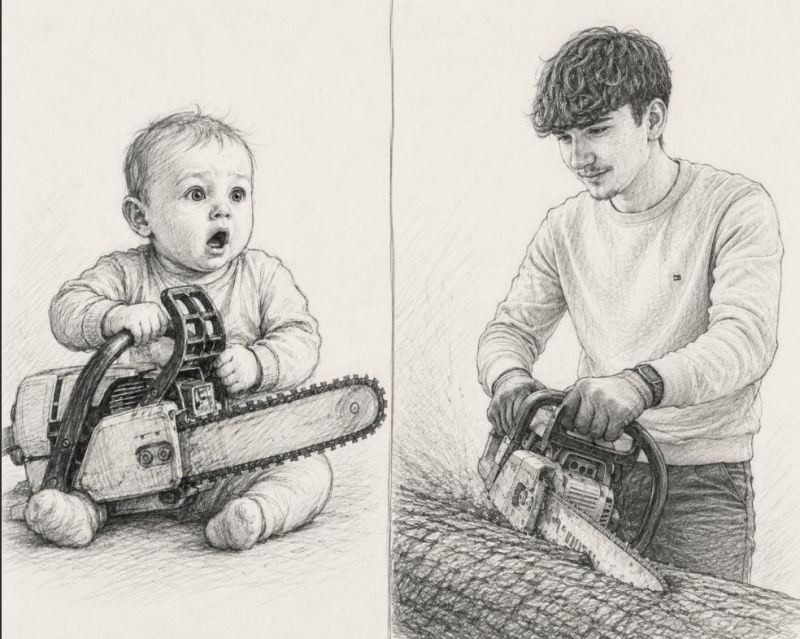
David is co-founder and CTO. Architecture, the data model and everything under the surface are his call: the decisions nobody sees until the business has doubled and the system either holds or it doesn’t.
“Most software fails the day the business changes shape. That’s the part worth designing for.”
It started with video games. There was no console in the house, so he played on his father’s home PC until the games he wanted outgrew it and it stopped meeting the system requirements. Finding the upgrades became his job. He read everything he could find on processors, graphics cards and memory, worked out what the machine needed and why, and somewhere in that research the games stopped being the interesting part. At ten he built his first PC himself.
The first things he wrote in Python were games of his own. A couple of extracurricular courses through CTYI and other organisations added C++, HTML, CSS and JavaScript. His father, Michael, has spent most of his career in Oracle databases and was the person he went to whenever something would not work, which was often.
At fifteen he started at Dan Twomey Waterpower Engineering, an Irish electricity supplier with its roots in small-scale hydroelectric generation. The job was mostly office admin, with some Python on the side: data scrapers and parsers, then the graphing and reporting that turned what they collected into something people could read. A year or two later the admin was gone and the job was development.
The whole business lived in a MySQL database, and the reports surfaced through an internal dashboard built in PHP. When the graphics outgrew what that could draw, he and his father, who works on the company’s billing system on the side, built a Flask server to handle them. It was internal work nobody outside the building would ever see, and it is where he learned what software looks like when a working business depends on it every day.
Alongside all of it there was football. In his own sixth year at Coláiste Treasa he founded the school’s soccer teams, starting with the under-17s, and the same season took on Kanturk AFC’s under-10s. Then came a gap year before college, and two teams became nine: he stayed with the Kanturk side as they moved up to under-11, took on Kanturk’s under-17s and helped with their under-15s, ran Coláiste Treasa’s under-15, under-17 and under-19 teams, and coached Rathcoole Rovers’ under-10s and under-14s along with the club’s Football For All group for children with disabilities. Some of those he managed outright; others he coached on or helped run as their seasons came and went.
He holds the FAI Grassroots, PDP1, PDP2 and PDP3 licences and the FA Talent ID Level 1, is a qualified referee, and has coached at FAI summer camps. Coaching asked for the same mix as engineering: read the problem analytically, then find a creative way through it, with tactics and methods built for the age group in front of him rather than one approach for every team.
That is how he met Alan. Alan was picked for the Coláiste Treasa team David had started, and later David coached Kanturk’s under-17s when the club asked him to help out. Plenty of people knew David was into tech, and Alan, looking back, had been scoping him out: what he was building, what his stack was, which tools he used. Then he asked what David thought about doing some websites together. He had only just started using AI in his own development at that point, and he went in head first. The websites came first; the move to custom software came soon after.
Today he leads the architecture and engineering on everything MTMN builds: the systems clients run their businesses on, and the studio’s own products, EOS, M.ind and LogOS. Most of the work is deciding what a system has to survive before anyone writes a line of it, then holding every build to that.
The way of working he built around AI is what lets a small but growing team deliver at that scale. A build is split into parts that can be worked on at the same time, AI does much of the first pass, and every part goes through review before it is accepted. Nothing reaches a client on the strength of a model saying it is finished. Polias is what that workflow became once it was worth giving to other people: everything he has learned about building with AI, turned into a tool.
It is also why software companies with their own development teams, some of them bigger than MTMN, now come to the studio for work. AI moves the work fast; the engineering is what keeps it standing. The test before anything ships is whether he would put his own name on it.