Industries

The job, the quote and the stock live in three different systems

Roughly fifty to five hundred staff, and the ERP or field-service platform was sized for a smaller company. The office keys the same figures two or three times while crews in the vans work from paper and WhatsApp. We rebuild the operation around one record.

Where the time actually goes

  • The ERP or field-service platform was bought for a smaller company and now runs on spreadsheets bolted to its sides.
  • The job, the quote, the stock and the drawings live in different systems, so the office keys the same figures two or three times.
  • Crews in vans work from paper and WhatsApp; the office re-types day sheets the next morning and the month-end report takes a week.

Systems we have already built

Field service

Vans, day sheets and drawings in one record

Field-service and job management rebuilt from a legacy platform and improved: van logins, day sheets, on-site drawings (sketch pad plus photo), crew certificates and office access grants in one record.

Accounts

The books talk to the job

Two-way links into the books (Sage-class accounting), historical records moved across cleanly, and LogOS, our own double-entry accounting engine, where a firm has none worth keeping.

Operations

One record, role by role

One operations record with role-based access and an audit log, hosted on your own AWS account in Ireland with 14-day point-in-time recovery and deletion protection.
In production

One record, start to finish

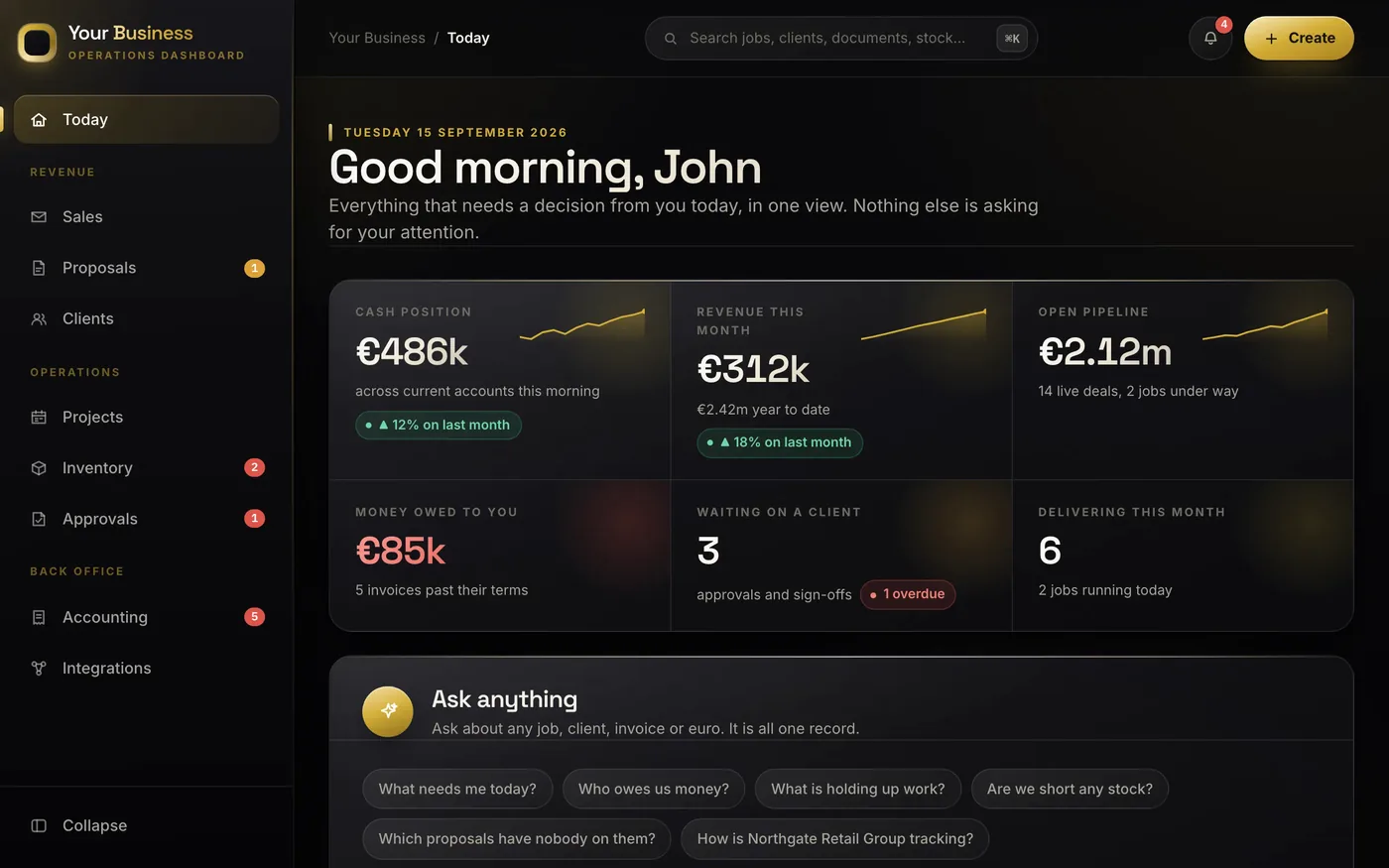
An Irish aluminium foundry replaced its field-service platform with a system we built on its own AWS account: vans, day sheets, drawings and the accounts in one record.

Operations dashboard
MTMN operations dashboard: cash position, revenue, pipeline and money owed on one screen

How an engagement starts

  1. Discovery call

    Thirty minutes, five questions

    A 30-minute scoping call with the engineers who would build it. Five questions first: your company size, your role, the system you run today, your timeline and a rough budget.

  2. Scoping

    A fixed-price scope

    We map the systems you run today against the workflow that actually happens, then send back a fixed-price scope and a delivery timeline.

  3. Build begins

    The people on the call build it

    Work starts against the agreed scope. The founders you spoke to are the ones who build it, through to handover.

Book a scoping call

A 30-minute scoping call with the engineers who would build it. Five questions first: your company size, your role, the system you run today, your timeline and a rough budget.